Adaptive Mixed Reality for safety training

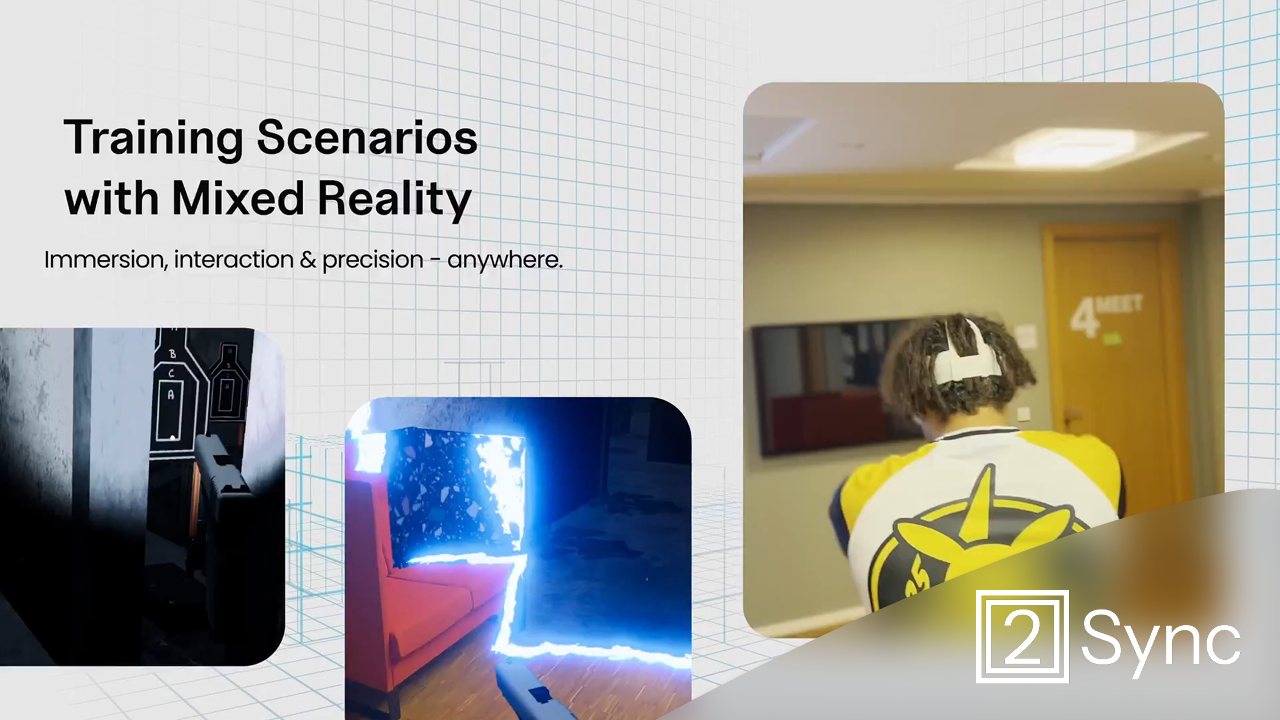
Realistic training often requires dedicated facilities, fixed layouts, and significant setup effort. We wanted to explore a different approach.Our prototype turns an existing room into an adaptive safety training scenario. The system uses spatial computing to understand the physical environment and automatically places training targets based on the available layout.

Participants move through the real space naturally. They walk around actual walls, furniture, and obstacles. This creates real spatial awareness and passive haptics, while the virtual layer adds interactive tasks and measurable training data.The prototype tracks movement, time, and accuracy. It can also introduce civilian placeholders to make the scenario less predictable and to emphasize careful decision-making over speed alone.This is not about entertainment or weapon glorification. It is a concept for structured training: how people move, react, coordinate, and make decisions in difficult situations.The value comes from scalability. Instead of building expensive training environments, existing locations can be used as realistic training spaces. Every room, office, apartment, or building can create a different scenario.

Auto-adaptive Mixed Reality makes this possible by adapting the experience to the real environment in real time.Any physical space can become a new training unit.